The second Shenzhen Science Fiction Week kicks off, taking you on a "time travel" to the Nantes International Science Fiction Festival in France
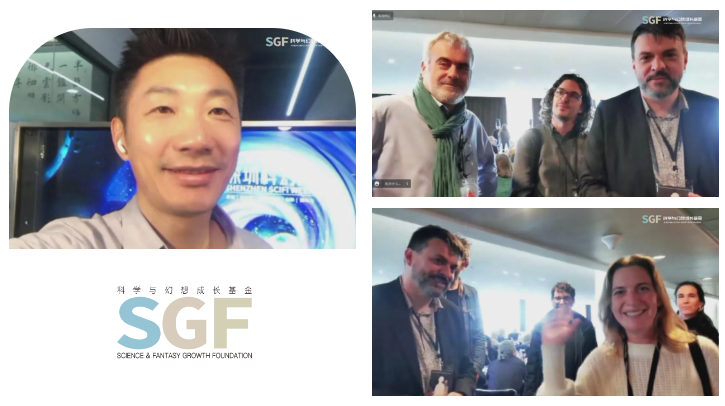
At 7 p.m. on November 1st, the second Shenzhen Science Fiction Week of 2022 was officially launched through a live broadcast via transoceanic connection, witnessed by the organizing committees of the Nantes International Science Fiction Festival in France and the Montreal Science Fiction Literary Festival in Canada. The Science Fiction Week aims to cultivate a local atmosphere of science fiction and scientific innovation in Shenzhen, enhance the popular awareness of science fiction culture, promote the industrial upgrading of science fiction culture, and facilitate the internationalization process of Chinese science fiction.
This year's Shenzhen Science Fiction Week kicks off after the successful convening of the 20th National Congress of the Communist Party of China. It will highlight the "international communication capability" of people-to-people exchanges and "enhance the efficiency of international communication" by participating in the Nantes International Science Fiction Festival in France through live streaming, allowing the world to know about "Shenzhen Science Fiction Week". According to the organizing committee, based on the experience of the first edition last year and in combination with the development trends of large-scale events at home and abroad, the 2022 Shenzhen Science Fiction Week will adopt "time travel" as the theme throughout the event. Content related to "time travel" will be set up at three levels: science fiction culture, internationalization, and science popularization. By engaging more people, the event aims to maximize the dissemination of cutting-edge technology and enhance Shenzhen's overall scientific literacy. This year's Shenzhen Science Fiction Week will present a diverse range of activities to the public, including live streaming programs from the Nantes Science Fiction Festival, creative salon sharing sessions by local Shenzhen writers, the "Science Popularization·Future" award ceremony for the Shenzhen Science Fiction Writing and Painting Competition for primary and secondary school students, series courses of the Red Scarf Science Fiction Imagination Creation Club, and science fiction reading and writing lectures at the Nanshan Youth Science Fiction Creation Base.
From the "utopia" described in Tao Yuanming's "The Peach Blossom Spring" that we are all familiar with, to the story of Wang Zhi, a woodcutter who "watched a game of chess in the cave and found that a thousand years had passed in the world" in "The Legend of the Cave Immortal" in the "Sui Book·Jing Ji Zhi", to the time-travel stories described in Liu Yiqing's work "You Ming Lu" during the Northern and Southern Dynasties, the term "time travel" is well-known in China. The creativity and innovation inspired by "time travel" are crucial for both ancient and modern people, both domestic and foreign, and in both literature and art as well as science and technology. They are key elements driving the progress of human society, historical civilization, and scientific and technological advancement.
The launch ceremony had a "time travel" flavor, as it "traveled" from Shenzhen, the science fiction twin city of China and France, to Nantes, bringing live broadcasts of the Nantes International Science Fiction Festival to the vast number of domestic science fiction fans. Ma Guobin, Chairman of the Shenzhen Science Fiction Week Organizing Committee, Aymeric Seassau, Deputy Mayor of Nantes, France, Axelle Roze, Chairman of the Nantes International Science Fiction Festival Organizing Committee, and Lauzon-dicso, Science Fiction Literature Advisor from Montreal, Canada, jointly witnessed the live broadcast to kick off this year's Shenzhen Science Fiction Week.
Ma Guobin, initiator of the Science Fiction Fund and chairman of the organizing committee of the second Shenzhen Science Fiction Week, explained that science fiction serves as an international language. Science fiction enthusiasts around the world can understand the concerns about the future expressed in works. Only science fiction works can embody such a grand narrative setting as "a community with a shared future for mankind". Good science fiction settings and stories define "international discourse power" and are a very good type of art that promotes and strengthens international communication.